Showing posts with label Concept Car. Show all posts

Monday, August 23, 2010

Pre-war Car Petr Novague ECO Car Concept Inspired by F1 Technology

The concept vehicle is christened as ECO and features tube car frame, half-hood body and carbon components that add minimum possible weight to this energy efficient and eco friendly vehicle. Created by Petr Novague as a mark of respect for Laurin and Klement, a pre-war Czech company, Further, chromium-molybdenum steel made lattice truss frame in the front part of the car is attached to the carbon frame with inside honeycomb.
The concept vehicle is combines the old traditions of pre-war cars with the modern and innovative technology and system logic.
Pre-war Car Petr Novague ECO Car Concept Inspired by F1 Technology
ECO is powered by the electric motors that are located in the narrow wheels. Electric motors are powered by the batteries located under the tilting front lid, which also works as door. With zero tail pipe emission, ECO offers clear and green ride added with comfort and range of 500 km per charge.
Hailed as “ECO,” the concept car features tube car frame, half-hood body and carbon components, which makes it a lightweight and energy efficient vehicle.
Pre-war Car Petr Novague ECO Car Concept Inspired by F1 Technology
Moreover, the ECO car can change it ground clearance, thanks to the double-wishbone axel disposes of the push rod suspension, uniball endings and impact dampers, according to the road or terrain.
Attaching the lattice truss frame, made in chromium-molybdenum steel, to the carbon frame with inside honeycomb upfront that is inspired by F1 technology, the retro-futuristic car also touts electronic drive-line (4 x 4) with stabilization system, which reduces the weight of mechanical connections by a huge margin.

2010 Volkswagen Sports Cars - VW Solar Powered Supercar Concept


It is a luxury supercar, it will only be built in a limited number of 200 units. It was designed to be able to cruise around in the year 2020. Volkswagen supercar presented at the 2010 Swansea Metropolitan University Degree Show in automotive design by Peter Wilkins not only promises to run by solar power with greater efficiency but also offers a competitive design styling.
2010 Volkswagen Sports Cars - VW Solar Powered Supercar Concept
Peter Wilkins has designed one helluva eco-friendly car for the 2010 Swansea Metropolitan University Degree Show. His supercar would run off of an electric motor powered by photovoltaic cells, or a hydrogen fuel cell stack. Peter Wilkins’ design is one of the sexiest eco-cars I have ever seen. Making earth-friendly cars that look good is a great idea.
The unique design of Wilkins permits each of the four wheels of the vehicle to be driven by an independent electric motor powered by solar energy stored in photovoltaic (PV) cells. The upper external surface of the vehicle stores the PV cells that further supply power to the mid-mounted hydrogen fuel-cell stack, which is directly linked to the electric motors. Placement of the PV cells and hydrogen fuel-cell stack form an integral part of the elegant design of the eco car that looks like part of a supercar.
The “VW Solar Powered Supercar” by designer Peter Wilkins is a concept car that demonstrates the aesthetic aspect of eco-friendly vehicles to attract more people toward sustainable commuting.
Simply known as the “VW Solar Powered Supercar”, this vehicle shows how just clean and green travel can get, and fast too. To power up, the car turns its face away from the smelly gas pump and integrates photovoltaic cells in its body instead. It uses these to juice up with solar power.

 2010 Volkswagen Sports Cars - VW Solar Powered Supercar Concept
The energy generated is used to power up a mid-mounted hydrogen fuel cell stack, resulting in a drive without the smoke and the pitch-black carbon footprint supercars usually leave behind these days.

Friday, August 20, 2010

2011 Volkswagen Beetle Ragster Concept Car Second Generation

Volkswagen to Launch the 2011 Beetle Based on the Beetle Ragster Concept car. Continued development of second generation of the Volkswagen Beetle that will be presented this year in November, as a concept car at the Salon in Los Angeles. Volkswagen is working on the second-generation of the new Beetle. The new car is expected to make a debut in concept form at the 2010 LA Motor Show later this year and will go on sale in 2011. A second generation Volkswagen Beetle will be launched next year, which would have more focus on driving dynamics rather than retro styling. The production version will debut at the Geneva Motor Show in 2011, and the year after arriving variant Cabriolet.
The Beetle will continue to be assembled in the plant in Puebla, Mexico, where it will be produced also the new Jetta. The two cars will share the new platform, characterized by a large step that will provide more cabin space for Beetle.
2011 Volkswagen Beetle Ragster Concept Car Second Generation
The second generation Volkswagen Beetle is a 2.0-liter engine producing 210 bhp (213 PS, 157 kW) could be seen on the car, more powerful than any engine currently sold on the vehicle. Also expected are 1.4-liter 160 bhp (162 PS, 119 kW) and 1.2-liter 105 bhp (106 PS, 78 kW) petrol engines. Diesel offerings could include 2.0-liter 140 bhp (142 PS, 104 kW) and 1.6-liter 105 bhp (106 PS, 78 kW) units. Customers in the US might get the chance to purchase the car with a five-cylinder 2.5-liter model cranking out 170 bhp (172 PS, 127 kW).
It is also said that the new car will have a heavily revamped interior. Engines will include the already existing 2.5-liter five-cylinder, a new 2.0-liter turbodiesel and a brand new hybrid version, powered by a 1.4-liter gasoline engine and a 27-horsepower electric motor. The engines will be mated with five and six speed manual transmissions and the new Volkswagen DSG dual-clutch gearbox.

Saturday, August 14, 2010

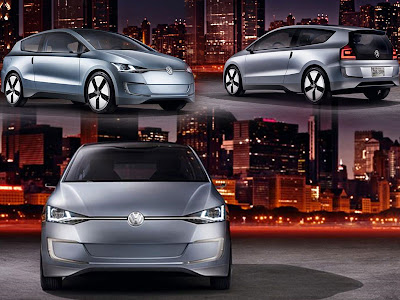
2010 Volkswagen Cars Up! Lite Diesel Electric Hybrid Concept Car

The Up Lite concept car is the harbinger of Volkswagen's new small car platform that should bear fruit in the form of a production Up Lite as early as the second half of 2011. The Up! Lite concept car ontinues the Volkswagen strategy of offering high-tech and high-end quality in all of its vehicle classes, making progress affordable for every car driver. The Up! Lite was designed to be a versatile vehicle that makes trips into the city, commutes to work and naturally long trips as well significantly less expensive and more eco-friendly.
The new concept car, based on Volkswagen’s New Small Family (the Up! models), incorporates a variation on the two-cylinder TDI hybrid powertrain from the L1 concept car unveiled earlier this year at the Frankfurt Motor Show. This small turbo-diesel hybrid possesses a small physical footprint--being much smaller than the VW Golf--and a super small carbon footprint, reaching an astronomical 70 US mpg fuel economy on the EU testing cycle. Volkswagen staged  the world premiere of the Up! Lite concept car at the LA Auto Show.
Naturally, on the Up! Lite there is nothing lacking in comfort or safety. ESP is on board, airbags are on board, ample space is on board, highly advanced information and control features are on board, and it is good to know that occupants are enclosed and protected by a highly innovative safety frame of aluminium, steel and carbon fiber.
The Volkswagen concept car has a top speed of 160 km/h (100 mph) and accelerates to 100 km/h in a respectable 12.5 seconds (0-60 mph in 12 seconds). The Volkswagen Up! Light with its extremely efficient engine might be the perfect example to exemplify this. Ultra light (less than 700 kilograms / around 1,500 pounds) it achieves a mileage of 2.44 liters for a 100 km (70 MPG).
The centerpiece of the Up! Lite powertrain is the newly designed 0.8 TDI two-cylinder turbo-diesel engine with a power of 38 kW / 51 PS. Furthermore, the electric motor (10 kW) – designed as a pulse start module (starter, alternator and E-drive) – also reduces the load of the TDI, provides added propulsion (boosting) and works to recover kinetic energy (regenerative braking). During boost phases – e.g. in a quick passing maneuver – the TDI and E-motor combine for a total power of 48 kW / 65 PS. Incidentally, a version of the TDI used in the Up! Lite was also used aboard the L1 concept car that Volkswagen presented in September at the IAA Motor Show in Frankfurt.
2010 Volkswagen Cars Up! Lite Diesel Electric Hybrid Concept Car
In two of its operating phases, the hybrid drive of the Up! Lite was designed to operate without any TDI propulsion at all. First phase: In so-called coast-down, activated by the driver taking his or her foot off the gas pedal (car coasts, TDI engine is shut off). Second phase: Over shorter distances, e.g. in residential areas, the E-motor can power the Up! Lite all by itself. In this case, a lithium-ion battery supplies the energy. Since it is capable of pure electric driving, the configuration is classified as a full hybrid. Shifting work is handled by a 7-speed Direct Shift Gearbox (DSG) like the one used in the new Polo. Moreover, the Volkswagen is equipped with a Stop-Start system.

Wednesday, August 4, 2010

2010 Mercedes-Benz Sports Cars SLS AMG E-Cell Concept

After stunning Mercedes-Benz SLS AMG supercar was revealed, electric version in the future. The all-electric Mercedes-Benz AMG E-Cell SLS prototype has slightly less power than its gas-powered siblings. The E-Cell has a capacity of probably the coolest name for a painting to date – AMG Lumilectric mango.
Mercedes-AMG is accepting the challenges of motoring of the future: the SLS AMG E-CELL is evidence of the state-of-the-art development of an exciting super sports car featuring a zero-emission high-tech drive. Boasting a power output of 392 kW and 880 Nm of torque, the technology vehicle from AMG is able to offer exceptional performance.
The E-Cell features a lithium-ion polymer battery pack and electric motors which produce 392 kW (526 bhp / 533 PS) and 880 Nm (649 lb-ft) of torque. That is enough to propel the SLS AMG E-Cell from 0-62 mph in 4.0 seconds, compared to 3.8 seconds in the standard SLS.
The gullwing model accelerates from zero to 100 km/h in 4 seconds – which almost puts it on the same high level as the SLS AMG with 6.3-litre V8 engine developing 420 kW (571 hp), which can accelerate to 100 km/h in 3.8 seconds.
The SLS AMG E-CELL drive incorporates a liquid-cooled high-voltage lithium-ion battery featuring a modular design with an energy content of 48 kWh and a capacity of 40 Ah. The maximum electric load potential of the battery, which consists of 324 lithium-ion polymer cells, is 480 kW, which is an absolute best value in the automotive sector.
A revised center console has a ten-inch touch-screen infotainment system, which runs audio, climate and navigation functions. The ten-spoke wheels are staggered 19-inch front and 20 inch rear tire wearing 265/35 and 295/30. The Mercedes-Benz AMG SLS E-Cell will make his debut in a production model in 2013, a value of $ 300,000.
2010 Mercedes-Benz Sports Cars SLS AMG E-Cell Concept 
With the SLS AMG E-CELL, the performance brand of Mercedes-Benz is launching a totally innovative drive solution for super sports cars and as such is among the pioneers in this market segment.

Renault Electric Sports Car DeZir Concept


Renault Electric Sports Car DeZir Concept
The Renault DeZir project is the first to have been led by Laurens van den Acker and marks the start of a sequence of concept cars that will provide an insight into Renault Design's new vision for the future. DeZir stands out as an illustration of the brand's commitment to more emotional styling.

The DeZir is a two-seater coupĂ© that Renault says stands out as an illustration of the company’s commitment to more emotional styling. With its sports car looks and ability to accelerate from 0 to 100 km/h (62mph) in five seconds, or 0 to 50 km/h in just two seconds, it’s hard to disagree.

Although the DeZir is purely a concept car at this point, Renault is strongly hinting that it shows not only the direction they plan on heading with sports cars in the future, but that it is indicative of a new overarching design and styling philosophy across the entire Renault brand.
The 'Z' in the name Renault DeZir is a direct reference to Renault's Z.E. signature, and several features of its design are suggestive of two qualities readily associated with electric mobility, namely advanced technology and light weight.

DeZir is powered by an electric motor mounted in a mid-rear position to optimize weight distribution over the front and rear wheels. The vertically-mounted 24kW/h lithium-ion battery is located behind the benchseat and provides the car with a range of 160km.
Battery cooling is ensured not only by the air channelled from the front to the back of the car, but also – and above all – by the flow of air that enters through the lateral scoops concealed behind the aluminium panels on either side of the body.

Employing the same principles as the KERS (Kinetic Energy Recovery System) seen in Formula 1, when the car decelerates, kinetic energy is recovered and stored in the battery. This energy can then be employed by the driver to provide a temporary power boost using a button located on the steering wheel. The car can be charged in 8 hours at 240-v, can get to 80% charge in 20 minutes at 4o0-v (3-phase) and will accept battery swapping made possible by the Better Place alliance.

The basic motor is the same as the unit used for Renault's production electric cars, although an evolution has enabled its power and torque to be uprated to 110kW (150ch) and 226Nm respectively. Through the extensive use of lightweight materials such as the Kevlar body, the DeZir tips the scales at just 830kg or 1,830 pounds. According to the French carmaker, the DeZir can go from zero to 100km/h (62mph) in 5 seconds and reach a top speed of 180km/h or 112mph.

The DeZir will debut in October at this year's Paris Motor Show, but no date has been set for its full release. According to Fast Company, by the end of 2013 the Renault-Nissan alliance hopes to produce 500,000 electric vehicles globally, including the 2011 Fluence ZE and the 2011 Kangoo ZE electric van.

Sunday, August 1, 2010

Supercar Imola - Ferrari Sports Car Concept by John Mark Vicente


 Supercar Imola Ferrari Sports Car Concept by John Mark Vicente
The another design by John Mark Vicente: the Ferrari Imola, after the sublime Bugatti Renaissance concept. According to the author, his Ferrari concept car is inspired by the Ferrari F70 created by Randy Rodriguez and the Dino Competizione by Sacha Selipanov.
This time, an Italian one that could give plenty of ideas to the designers at Ferrari. Imola is a spider without windscreen and has a future hybrid Ferrari V6 engine. The designer used triangular and trapezoidal shapes to create the head and tail lights and the grille.

The enormous rims and semi-slick tires underline the aggressiveness of the vehicle. This supercar is ready to take on the road monsters like Ariel Atom, Caparo T1, KTM X-Bow and especially the Lotus Elise.


 Supercar Imola Ferrari Sports Car Concept by John Mark Vicente

Tuesday, July 27, 2010

2010 Ferrari Sports Cars 612 GTO Concept Cars

 2010 Ferrari Sports Cars 612 GTO Concept Cars
Sasha calls himself 'the angry car designer' for some reason, and has no time for fools. A pure conceptual study for a top-end Ferrari, possibly a future generation of the 612 Scaglietti, Selipanov design proposal appears to borrow bits and pieces from certain supercars like the Aston Martin One-77 as well as Maranello’s own 458 Italia.
The Ferrari 612 GTO concept is the work of Sasha Selipanov, an extremely talented, and also incredibly irate, automotive designer based in Berlin, Germany.
The 612 GTO concept is a proposal for the next generation 612 Scaglietti, but with a high-performance GTO twist and completely revised aesthetics. Sasha calls himself 'the angry car designer' for some reason, and has no time for fools.
For the 612 GTO concept Sasha has used influences from the classic Ferrari 250 GTO - which is evident in the triple air intakes molded into the hood.
2010 Ferrari Sports Cars 612 GTO Concept Cars

Monday, July 26, 2010

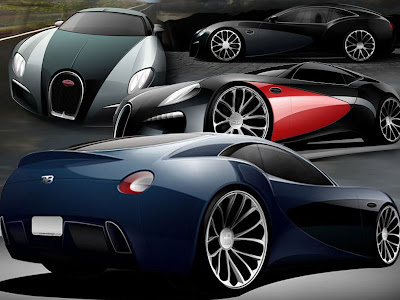
Bugatti Sports Cars Type 12-2 Concept Car

Bugatti Sports Cars Type 12-2 Concept Car
Here is a Bugatti Concept Car – Bugatti Type 12-2. Racer X has lifted the covers on a new concept vehicle they are calling the Bugatti Type 12-2 concept car which is highlighted by ample storage space and new practical designs. Bugatti is a most famous sports car manufacture, so it is just about power, speed, luxury and everything, designed especially for those who love speed, comfort and style.

Bugatti Type 12-2 concept has been created as a 2+2 sports GT for the Bugatti brand. it is not intended for production. Designed as an example of a luxurious four seater GT, the type 12-2 is the artwork of Reuben Zammit.

The idea is to use a VW derived W12 engine with a twin turbo layout hence the name 12-2. Although not as extravagant as the W16 used in the Veyron, there would be enough power to propel the Type 12-2 to over 200 mph. Every time it competed with 4 different demo cars in 2 different classes for bodystyling.

On the subject of performance, things get considerably more hypothetical. This being purely a design study (and not even a Bugatti-commissioned one) any power-train speculation should be taken with more than a few grains of salt. Racer X's specified FR configuration seems to eliminate the Veyron's all-wheel drive, quad-turbo W-16 configuration. Meanwhile, the name "12-2" seems to hint at a 12-cylinder mill sleeping beneath the coupe's hood.


Bugatti Sports Cars Type 12-2 Concept Car
Pop over to Racer X Design for more images of the Type 12-2 Streamliner concept. While you're there, check out the rest of its portfolio, which features a few wild takes on Chrysler, BMW, and Alfa Romeo vehicles.